
Donald Trump vs Kamala Harris: Inside the Real-Time Machine Learning Predicting the 'Unpredictable' 2024 USA Election on Allora
Greyscope Teams
Transforming ideas, Empowering innovation
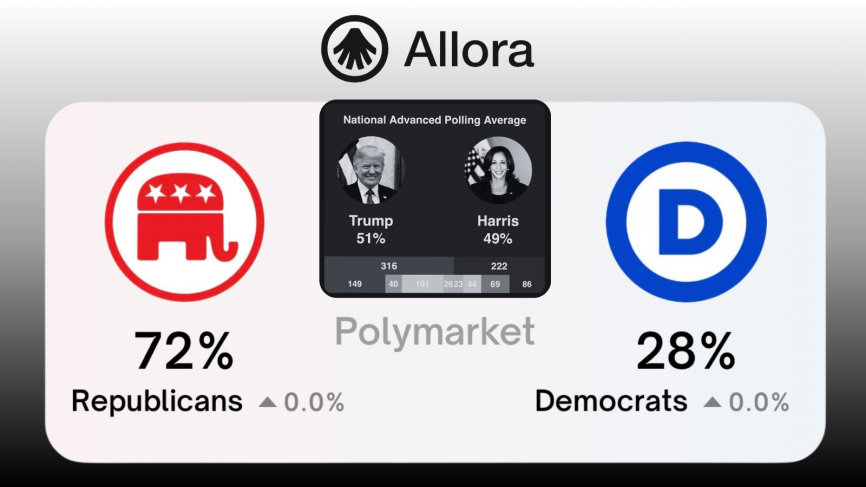
Predicting the outcome of a major geopolitical event is a complex challenge that has captured the attention of data scientists and political analysts for decades, and the 2024 U.S. Presidential Election between Donald Trump and Kamala Harris was no exception. Historically, data-driven forecasting relied on aggregating traditional opinion polls. While effective in stable environments, these legacy methodologies possess severe structural limitations, notably systemic polling bias and a distinct inability to absorb sudden macroeconomic shocks.
When an entire ecosystem of pollsters shares a unified directional bias, predictive models suffer catastrophic failures—much like the historic 2016 election cycle. To bypass these vulnerabilities, modern quantitative analysis must shift away from lagging sentiment surveys toward active, capital-backed prediction markets like Polymarket.
However, running an advanced machine learning model in isolation does not provide enterprise utility. This operational friction is precisely why Greyscope Labs participated in running real-time predictive inferences throughout the 2024 election cycle. As a deep tech foundry focused on end-to-end engineering, we don't just advise; we build. By taking the core thesis outlined in Allora Network's research piece on predictive election modeling, our team successfully operationalized a production-grade Allora Worker Node framework on Topic 11 to process live, high-frequency geopolitical data feeds.
Processing Geopolitical Volatility with Real-Time Inferences
The primary directive of Greyscope’s infrastructure on Allora's Topic 11 was to compute and transmit a definitive, daily probability distribution ($0 - 100%$) representing the likelihood of a specific party winning the presidency.
By deploying isolated inference pathways, our system handled the complex, real-time probability shifts for the core political contenders:
- TOKEN = R (Donald Trump / Republican Party): The engine captured continuous market feeds to output the verified mathematical likelihood of a Republican victory.
- TOKEN = D (Kamala Harris / Democratic Party): The model processed real-time trading volumes to forecast the likelihood of a Democratic victory.
Instead of relying on static architectures, Greyscope Labs integrated an automated data updater mechanism into the node pipeline. Every 24 hours, the system fetched fresh metrics directly from decentralized market APIs, committed the entries to local data structures, and served validated time-series inferences to the blockchain.
Production-Grade MLOps: The Greyscope Blueprint
Our multidisciplinary team approach demands that every deployment adheres to strict enterprise standards. Moving a data science model from an experimental script into a resilient, autonomous loop required a highly structured, containerized architecture.
./root/allora-usa-election
├── config.json (RPC Gateway & Validation Settings)
├── docker-compose.yml (Container Orchestration)
├── app.py / model.py (Tuning & Regression Layer)
└── inference-data / worker-data (Volume Isolation)
To maintain our commitment to architectural stability, the node configuration enforces clear segregation of computational workflows:
1. Hardened Volume Isolation
The system implements strict multi-volume separation between the worker-data directory—which registers network state parameters directly to the Allora chain—and the inference-data block. The inference-data volume safely houses the localized dataset.csv and serialized models (model.pkl) for both party paths, allowing our engineers to execute hot-swappable model tuning without interrupting node connectivity or dropping off-chain.
2. Automated Retraining & Serving
Within the customized model.py scripts, the infrastructure applies optimized regression algorithms (such as tuned Support Vector Regression) to process the raw, incoming time-series datasets. These Inferences are served internally via a localized Flask application (app.py), outputting verified probability metrics directly to the primary worker module every single day.
Maximizing Performance in Decentralized Networks
On the Allora Network, network points and delegation weights are strictly meritocratic. Rewards depend entirely on how accurately your node's autonomous inference predicts the real-world ground truth relative to the rest of the network. Unstable node architectures or poorly tuned models result in immediate performance degradation.
By embedding sophisticated time-series forecasting logic into a hardened Docker framework with dedicated RPC nodes and automated daily update candences, Greyscope Labs ensured consistent transaction confirmations on-chain.
This project perfectly highlights the core value of Greyscope Labs. We approach the End-to-End Discovery Layer by turning intricate data science challenges into robust, production-ready digital systems—demonstrating that autonomous AI infrastructure can reliably decode high-stakes, real-world probability markets at scale.
-
Source by : Greyscope/0xgrey - Guides Github
-
Allora Network : Dashboard Overview
-
Allora Network's research piece on predictive election modeling